Utrecht municipality / Gemeente Utrecht (U) part 1/2 This capital of the province of the same name is one of the oldest cities in the country with its first origins dating from the Roman period, when a castellum called Trajectum ad Rhenum was built. After that it became a major Frisian, and later Frankish, town. In 696 Utrecht became a bishop's see. From here the conversion of much of the country began. The city was chartered in 1122, had its greatest prosperity in the 11th and 12th centuries, but throughout the Middle Ages it remained the most powerful and important town in the northern Netherlands. Until the 16th century, when it lost this position to Amsterdam, it was the largest city of the northern Netherlands. Despite the Reformation, when Utrecht became a protestant city officially, a large catholic minority remained. In 1723 the Roman Catholic church lost many members to the new Old-Catholic church. The city is the seat of two bishops; the Roman Catholic archbishop and a bishop of the Old-catholics. Beginning in the second half of the 19th century, Utrecht has expanded beyond its historic borders. Churches in these "new" parts of the city are shown on page 2, while this very page only shows churches in the historic town centre. Deze hoofdstad van de gelijknamige provincie is een van de oudste steden van het land, met zijn eerste oorsprong daterend uit de Romeinse periode, toen een castellum genaamd Trajectum ad Rhenum werd gebouwd. Daarna werd het een belangrijke Friese, en later Frankische, stad In 696 werd Utrecht een bisschopzetel. Vanaf hier begon de kerstening van een groot deel van het land. De stad kreeg stadsrechten in 1122, had zijn grootste bloei in de 11e en 12e eeuw, maar bleef in de Middeleeuwen de machtigste en belangrijkste stad in de Noordelijke Nederlanden. Tot in de 16e eeuw, toen het deze positie verloor aan Amsterdam, was het de grootste stad van Noord-Nederland. Ondanks de Reformatie, toen Utrecht officieel een protestantse stad werd, bleef een grote katholieke minderheid voortbestaan. In 1723 verloor de rooms-katholieke kerk veel leden aan de nieuwe Oud-Katholieke kerk. De stad is de zetel van twee bisschoppen, de Rooms-katholieke aartsbisschop en een bisschop van de Oud-katholieken. Vanaf de tweede helft van de 19e eeuw is Utrecht buiten haar historische grenzen gegroeid. Kerken in deze "nieuwe" delen van de stad worden getoond op pagina 2 terwijl deze pagina aleen kerken toont in het historische stadscentrum. |
| Utrecht old centre |
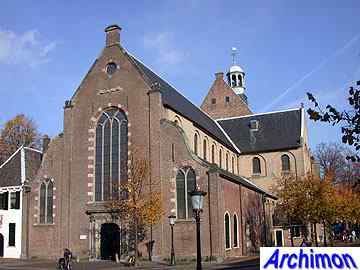
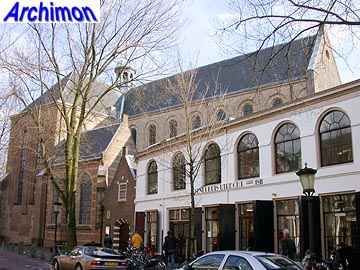 The Pieterskerk
is Utrecht's oldest church and was completed in c. 1048. Of the Romanesque
churches in Utrecht, the St. Pieter is the best preserved, both outside
and inside, even though it has had some changes in Gothic style, and
its two towers were destroyed centuries ago. The Pieterskerk
is Utrecht's oldest church and was completed in c. 1048. Of the Romanesque
churches in Utrecht, the St. Pieter is the best preserved, both outside
and inside, even though it has had some changes in Gothic style, and
its two towers were destroyed centuries ago.
Location: Pieterskerkhof 5 De Pieterskerk is de oudste kerk van Utrecht en werd rond 1048 voltooid. Van alle romaanse kerken in Utrecht is de St. Pieter de best bewaarde, zowel aan de buiten- als aan de binnenkant, ook al heeft het gebouw een aantal wijzigingen in gotische stijl ondergaan en zijn de twee torens eeuwen geleden verwoest. Locatie: Pieterskerkhof 5 |
|
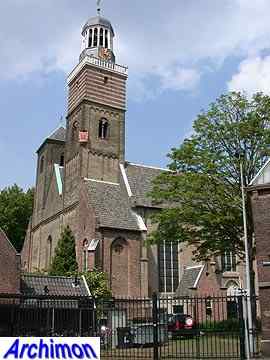
Despite its Renaissance facade, the Janskerk or St. Jan is another Romanesque church and only a little younger than the St. Pieter. Originally both churches were very similar, but the St. Jan's choir was replaced by a bigger Gothic choir in the 16th century. Location: Janskerkhof 26 Ondanks de gevel in Renaissancestijl is de Janskerk of St. Jan een romaanse kerk en weinig jonger dan de St. Pieter. Oorspronkelijk waren beide kerk vrijwel gelijkm naasr het koor van de St. Jan werd in de 16e eeuw vervangen door een groter gotisch koor. Locatie: Janskerkhof 26 |
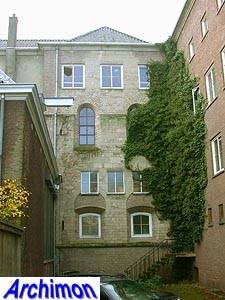
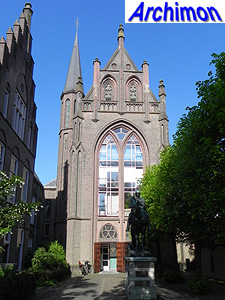
Another Romanesque church was the church of St. Paul's abbey which was built shortly after the previous two churches and was demolished in 1707, except for the choir which survived until 1804. Only the facade of the southern transept-arm remains as the northern facade of another building. Location: Hofpoort Een andere romaanse kerk was de kerk van de St. Paulusabdij die kort na de vorige twee kerken werd gebouwd en die in 1707 werd gesloopt met uitzondering van het koor dat nog tot 1804 bleef behouden. Alleen de gevel van de zuidelijke transept-arm resteert als de noordgevel van een ander gebouw. Locatie: Hofpoort
|
|
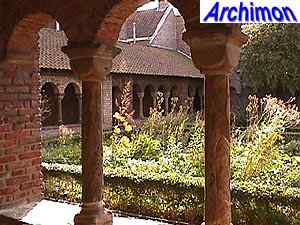
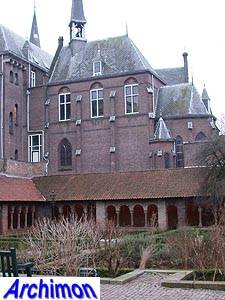
The St. Marie or Mariakerk (Church of Mary) was a unique example of Romanesque architecture, being modelled after Italian churches, but unfortunately, after its demolition in 1813 all that remains of it is the cloister. Location: Mariaplaats De St. Marie of Mariakerk was een bijzondervoorbeeld van romaanse architectuur, ontworpen naar voorbeeld van kerken in Italië, maar helaas bleef na de sloop in 1813 alleen de kloostergang bewaard. Locatie: Mariaplaats |
|
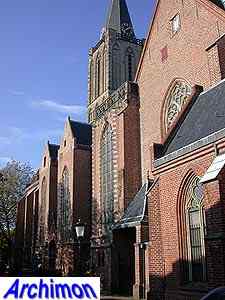
The Nicolaikerk is one of Utrecht's original four parish churches. This is a late-Gothic church with a few Romanesque parts, especially at the western facade, a reminder of the original church from the 12th century. One of its two towers was heightened in 1586 to accomodate a carillon. Location: Nicolaaskerkhof 9 De Nicolaikerk is een van de oorspronkelijke vier parochiekerken in Utrecht. Deze laat-gotische kerk heeft een aantal romaanse onderdelen, met name de westelijke gevel, een overblijfsel van de oorspronkelijke kerk uit de 12e eeuw. Een van de twee torens werd verhoogd in 1586 om plaats te bieden aan een carillon, Locatie: Nicolaaskerkhof 9
|
|
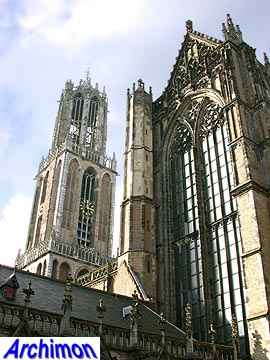
Of the cathedral or Dom little more remains than the tower, which always stood seperately from the main building, the transept and the choir. A storm destroyed the nave in 1674. Still, what is left is huge and very impressive. This is the only church in The Netherlands built in the original French Gothic style, all other Gothic churches in the country belong to one of the many regional variants. Location: Domplein 31 Van de kathedraal of Dom resteert weinig meer dan de toren, die los stond altijd van de eigenlijke kerk, alsmede het transept en het koor. Een storm verwoestte het schip in 1674. Desondanks is dit restant groot en indrukwekkend. Dit is de enige kerk in Nederland die werd gebouwd in de originele Franse gotische stijl, alle andere gotische kerken in het land behoren tot een van de vele regionale varianten. Locatie: Domplein 31 |
|
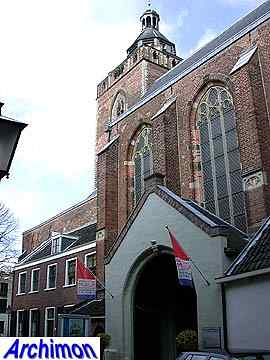
The Buurkerk (citizen's church) until 1125 was the only church available to the citizen's of Utrecht, with all other churches reserved for the clergy only, hence the name of the church. The building nowadays houses a museum of organs. Location: Steenweg 6 De Buurkerk (burgerkerk') was tot 1125 de enige kerk die ter beschikking stond van de burgers van Utrecht, terwijl alle andere kerken alleen bestemd waren voor de geestelijkheid, vandaar de naam van de kerk. Het gebouw huisvest tegenwoordig een museum van organen. Locatie: Steenweg 6
|
|
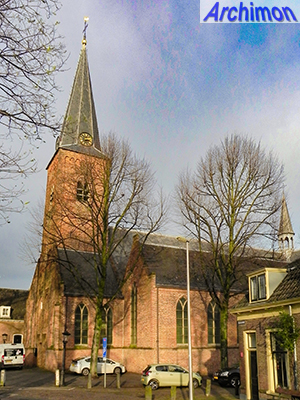
The Jacobikerk (church of St. Jacob) is also one of the four former parish churches from the Middle Ages in Utrecht's center, although it has been in protestant hands long since. A noteworthy feature of this church is the row of small houses that has been built against its front. Location: Jacobskerkhof 22 De Jacobikerk is ook een van de vier voormalige parochiekerken uit de Middeleeuwen in het centrum van Utrecht, hoewel het reeds lang in protestantse handen is. Opmerkelijke is de rij van kleine huizen die tegen de voorkant is gebouwd. Locatie: Jacobskerkhof 22
|
|
In 1853, when the catholic hierarchy was fully restored in the Netherlands and the catholics had given up their demands for the return of the big cathedral, the St. Catharijne was chosen to be the new Roman Catholic cathedral. It was the only church restituted to the catholics in this city, and it was drastically enlarged by architect A. Tepe. Location: Lange Nieuwstraat 36 In 1853, toen de katholieke hiërarchie in Nederland volledig werd hersteld en de katholieken hun aanspraken op de Domkerk hadden opgegeven, werd de St. Catharijne gekozen als de nieuwe rooms-katholieke kathedraal. Het was de enige kerk in deze stad die gerestitueerd werd aan de katholieken, en het gebouw werd drastisch uitgebreid door architect A. Tepe. Locatie: Lange Nieuwstraat 36 |
|
Location: Geertekerkhof 23 De Geertekerk is een driebeukige gotische kerk met romaanse elementen. Tussen 1930 en 1953 viel deze kerk bijna ten slachtoffer van de intolerantie van de hervormden, die het gebouw liever lieten instorten dan het terug te geven aan de katholieken. Gedurende vele jaren was het een totale ruïne, totdat werd besloten dat de remonstranten het gebouw mochten kopen. Locatie: Geertekerkhof 23
|
|
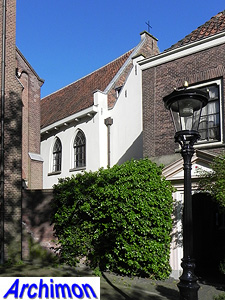
The
Old-Catholic St. Gertrudis chapel is a former hidden church, built in ca. 1640.
It served as a church until 1914, when the current Old-Catholic cathedral next
to it was completed.
Location: Mariahoek 9 De Oud-Katholieke St. Gertrudiskapel is een voormalige schuilkerk, gebouwd
in ca. 1640. Het gebouw diende als kerk tot 1914, toen de huidige Oud-Katholieke kathedraal ernaast werd voltooid. Locatie: Mariahoek 9 |
|
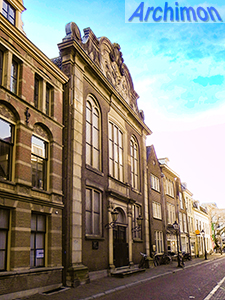
This facade in Louis IV-style, designed by Jan Cloppenburg and built in 1745, belongs to the Lutheran church. Part of this church is the former chapel of a convent which was build here in 1412. Location: Hamburgerstraat 9 Deze gevel in Lodewijk IV-stijl, ontworpen door Jan Cloppenburg en gebouwd in 1745, behoort tot de Lutherse kerk. Een deel van deze kerk is de voormalige kapel van een klooster dat hier werd gebouwd in 1412. Locatie:
Hamburgerstraat 9 |
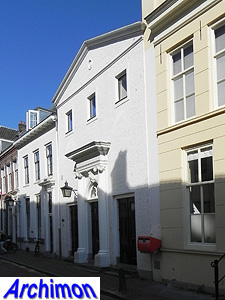
The Silokerk, a
building in neo-Classical style, was built in 1820 as a catholic church, first named
St. Augustinus, later St. Willibrordus. It closed as a catholic church in 1877,
had several profane functions since and in 1910 became a reformed church and was
given the current name. In 1949 it became a Baptist church.
Location: Herenstraat 34-36 De Silokerk, een gebouw in neoclassicistische stijl, werd gebouwd in 1820 als
een katholieke kerk met de naam St. Augustinus, later St. Willibrordus. Zij werd
als katholieke kerk in 1877 gesloten en had daarna een aantal profane
functies en werd in 1910 werd een hervormde kerk met de huidige naam. In 1949
werd het een baptistenkerk. Locatie: Herenstraat 34-36 |
|
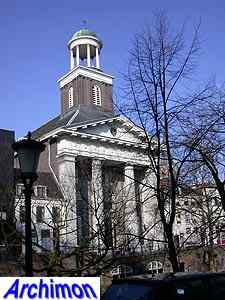
This Roman Catholic church, the St. Augustinus, was designed by K. Zocher and built from 1838 to 1840. It's built in a neo-Classical style that is often, and incorrectly, called Waterstaat-style, although the term neo-Grec is also used and seems more appropriate, as the style is obviously inspired by ancient Greek temples. Location: Oudegracht 69 Deze rooms-katholieke kerk, de St. Augustinus, werd ontworpen door K. Zocher en gebouwd in 1838-1840. Het is gebouwd in een neoclassicistische stijl die vaak, en ten onrechte, Waterstaatstijl wordt genoemd, hoewel de term neo-Grec ook wordt gebruikt, een benaming die meer van toepassing is omdat de stijl duidelijk is geïnspireerd door de antieke Griekse tempels. Locatie:
Oudegracht 69 |
|
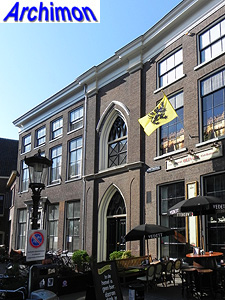
The Old-Catholic St. Maria Minor is an aisleless church with a neo-Gothic facade, built in 1860-1863 to a design by Th.G. van Doorn. It was built on the site of a former hidden church. It's now a bar. Location: Achter Clarenburg 4 De Oud-Katholieke St. Maria Minor is een zaalkerk met een neogotische voorgevel, gebouwd in 1860-1863 naar een ontwerp door Th.G. van Doorn. De kerk werd gebouwd op de locatie van een voormalige schuilkerk. Het is nu een café. Locatie: Achter Clarenburg 4
|
|
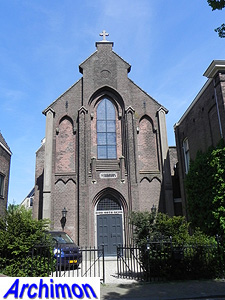
The Old-Catholic St. Jacobus is an aisleless church in early neo-Gothic style, designed by architect G. Gerritsen and built in 1870. It's now a house. Location: Bemuurde Weerd Oostzijde 56 De Oud-Katholieke St. Jacobus is een zaalkerk in vroege neogotische stijl, ontworpen door architect G. Gerritsen en gebouwd in 1870. Het is tegenwoordig een woonhuis. Locatie: Bemuurde Weerd Oostzijde 56 |
|
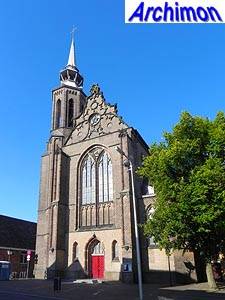
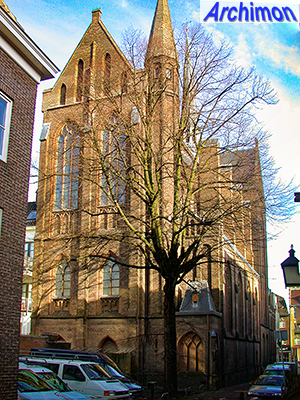
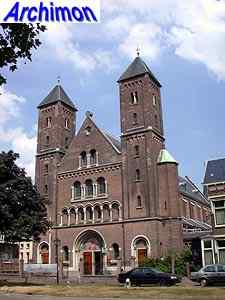
The St. Willibrordus is a remarkably tall neo-Gothic catholic church. This was the only way to make the church really noticeable, as it was built on a small piece of land which was closed in by other at three sides, the only free side being a narrow alley. The church was designed by architect A. Tepe, and dates from 1876-1877. Location: Minrebroederstraat 21 De St. Willibrordus is een opmerkelijk hoge neogotische katholieke kerk. Dit was de enige manier om de kerk echt op te laten vallen, want het bouwterrein was aan drie zijden afgesloten door huizen, terwjl de enige vrije kant een smal steegje is. De kerk werd ontworpen door architect A. Tepe en dateert 1876 tot 1877. Locatie: Minrebroederstraat 21
|
|
Location: Kromme Nieuwegracht 62 De voormalige Remonstrantse kerk werd door de remonstranten gebruikt van 1886 tot 1956, toen zij verhuisden naar de middeleeuwse Geertekerk. Het gebouw werd ontworpen door F.J. Nieuwenhuis in neoromaanse stijl. Locatie: Kromme Nieuwegracht 62
|
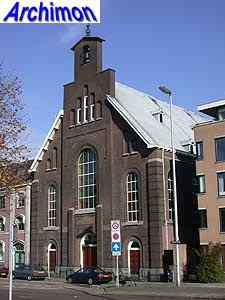
The Gereformeerde Westerkerk dates from 1891 and was designed by A. Calcoen. It is a late example of a church in neo-Classical style. It's now a hotel. Location: Catharijnekade 9 De Gereformeerde Westerkerk dateert uit 1891 en is ontworpen door A. Calcoen. Het is een laat voorbeeld van een kerk in neoclassicistische stijl. Het gebouw is tegenwoordig een hotel. Locatie: Catharijnekade 9 |
|
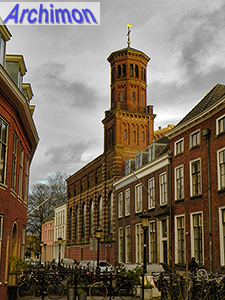
The catholic hospital St. Joannes de Deo is a Neo-Gothic complex designed by J. van Kesteren and built in 1895-1896. Part of the complex is this chapel.The former hospital now houses a conservatory. Location: Mariaplaats 8 Het katholieke ziekenhuis St. Joannes de Deo is een neogotisch complex, ontworpen door J. van Kesteren en gebouwd in 1895-1896. Deel van het complex is deze kapel. Het voormalige ziekenhuis is nu een conservatorium. Locatie: Mariaplaats 8
|
|
Another church designed by A. Tepe is the St. Martinus, a Neo-Gothic cruciform basilica built in 1901 with a richly ornamented facade. The church was closed in the 1970's and was rebuilt into apartments in 1988. Location: Oudegracht 403 Een andere kerk naar ontwerp van A. Tepe is de St. Martinus, een neogotische kruisbasiliek uit uit 1901 met een rijk versierde voorgevel. De kerk sloot in de jaren '70 en werd in 1988 omgebouwd tot appartementen. Locatie: Oudegracht 403
|
|
Utrecht's third cathedral is the Old-Catholic St. Gertrudis, built in 1912-1914 and designed by E.G. Wentinck. To emphasize the difference with the Roman Catholic church, and in memory of the former church St. Marie, this church was built in Neo-Romanesque style. Location: Willemsplantsoen 2 De derde kathedraal van Utrecht is de Oud-Katholieke St. Gertrudis, die dateert uit 1912-1914 en is ontworpen door E.G. Wentinck. Om het verschil met de rooms-katholieke kerk te benadrukken, en als herinnering aan de voormalige kerk St. Marie, werd de kathedraal gebouwd in neoromaanse stijl. Locatie: Willemsplantsoen 2
|
|
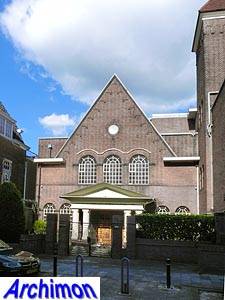
The former synagogue was designed by H. Elte and built in 1926, although the neo-Classical portal suggest a higher age. Location: Springweg 164 De voormalige synagoge werd ontworpen door H. Elte en gebouwd in 1926, hoewel het neoclassicistische portaal een hogere leeftijd suggereert. Locatie: Springweg 164
|
|
Back to the Province of Utrecht |
|
|