
Scheveningen (ZH): O.L. Vrouwe van Lourdeskerk (A.J. Kropholler & C.M. van Moorsel, 1911-1926)
 When
in 1911 A.J. Kropholler was commissioned to design a catholic complex in
Scheveningen, it was only his second assignment in religious architecture, the
first being the remodelling of the chapel of a convent in Velp. It was also his
first assignment for a Roman Catholic complex in a
mostly protestant environment, the first of several such complexes Kropholler
designed in his long career.
When
in 1911 A.J. Kropholler was commissioned to design a catholic complex in
Scheveningen, it was only his second assignment in religious architecture, the
first being the remodelling of the chapel of a convent in Velp. It was also his
first assignment for a Roman Catholic complex in a
mostly protestant environment, the first of several such complexes Kropholler
designed in his long career.
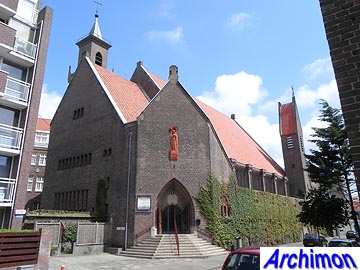
Although Kropholler had designed many buildings before, he had never built a church. His very first church would be a small and simple temporary church, built in 1911-1912 to offer accomodation to the parish while construction of its new buildings lasted. Despite its temporary nature and its plain exterior, this first church examplified already a few important elements of Kropholler's style, reflecting his ideas about architecture as well as liturgy; visible brickwork, a wide nave without any disturbing pillars, a tall roof supported by a visible wooden beam construction and an undeep choir which was seperated from the nave by a chancel arch. One aspect Kropholler would never repeat again; the choir is illuminated by a big window at its back, thus effectively blinding the attendants when sunlight fell on it.
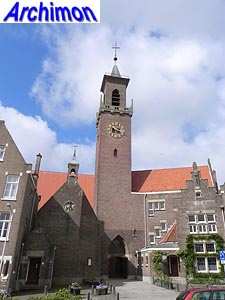
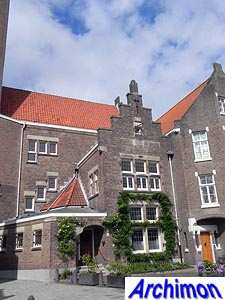
The actual complex would encompass thirteen houses, a chapel, a presbytery, a school and a permanent church with a free standing tower. The church and the school would be located behind the other buildings, which themselves would flank the tower. This tower would also be the gate to the church. A compact reflection of a medieval city.
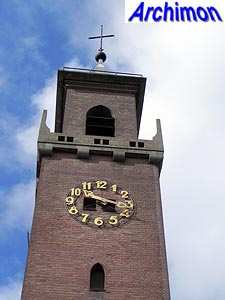
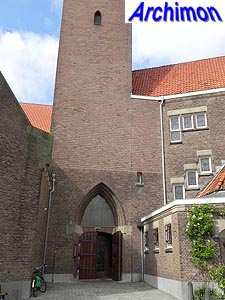
Work on the actual complex began once the temporary church was finished. The chapel, the presbytery and the houses were completed according to the design, but of the church only the lower part of the tower was built. The Den Haag municipality, of which Scheveningen was, and is, a part, did not accept the design for the tower because of its extending balustrades. Instead of changing the design Kropholler quit the job in 1918 and the parish was forced to use the temporary church for the next thirteen years. In 1920 C.M. van Moorsel, by Kropholler's recommendation, was commissioned to complete the church. He made a new design which was built in 1925-1926. Kropholler himself was invited in 1920 to become member of the Schoonheidscommissie ('beauty committee'), the very municipal organ that had rejected his tower. He accepted the invitation.
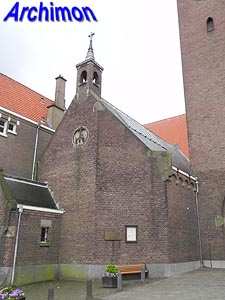
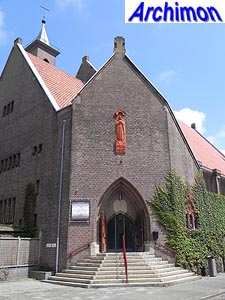
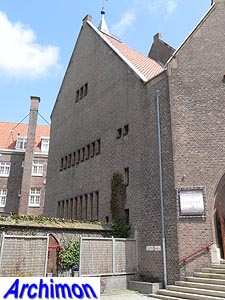
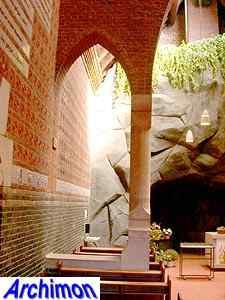
Both Kropholler's and Van Moorsel's parts of the building are in Traditionalist style. Although the Delft School movement of Traditionalist architecture wasn't formed until the 1920's (and actually wasn't called like that until the late 1940's), Kropholler's Lourdes chapel can be regarded as a very early example of the style that became synonomous for the movement. As Kropholler's first complete religious work, not counting the temporary church and the new facade he added to the chapel in Velp, it's also typical for his style for such buildings which hardly changed in the next four decades. An unusual feature of the chapel is the front, which is made of two parts, one of which is bevelled, to draw attention to the main entrance of the church. In the other part is a sculpture of a pelican feeding its young with its own blood; this sculpture was made by Joseph Mendes da Costa, who made several similar sculptures for some of Kropholler's later churches as well. The chapel itself is an aisleless brick building. It's covered by a roof on a wooden construction.
Van Moorsel's church was mostly completed in December 1925 and was consecrated at Christmas. Shortly thereafter the temporary church was demolished and the church was completed with the portal. On the remaining space a school was built, which has already been demolished.
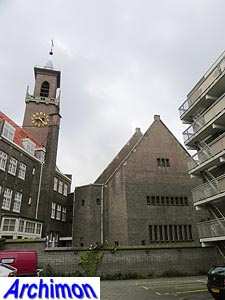
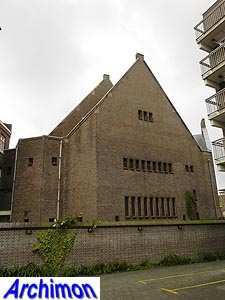
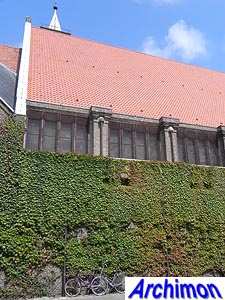
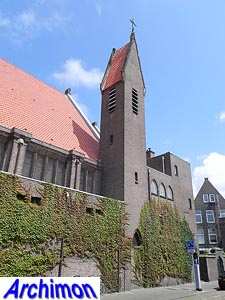
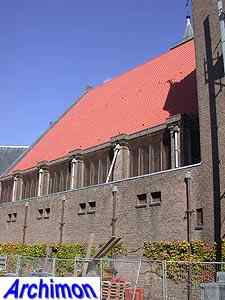
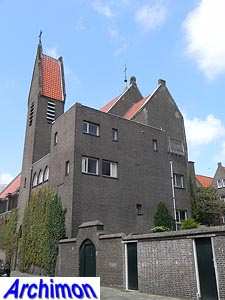
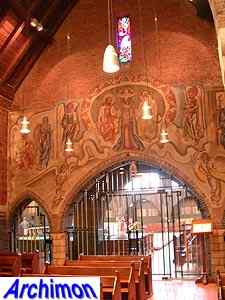
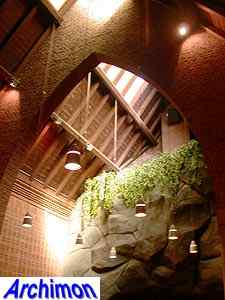
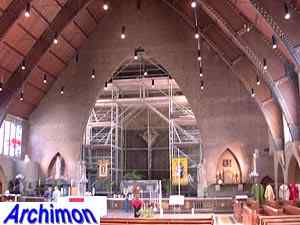
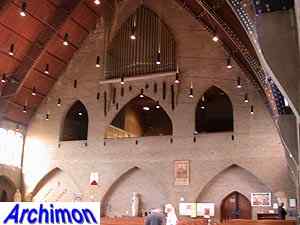
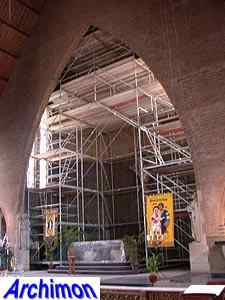
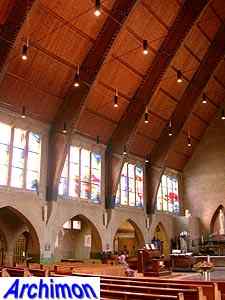
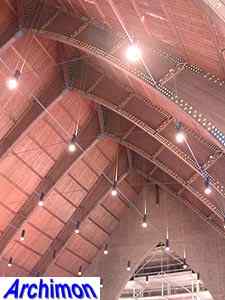
The completed church is in a style that has obvious similarities to Kropholler's work. This illustrates that, even though M.J. Granpré Molière lead the so-called Delft School, it was Kropholler who pioneered the style it became known for. It is a three-aisled building with a very wide central aisle and narrow side-aisles, just like Kropholler's original design. The tall roof is supported by large wooden arches which are made up of many parts of bent wood held together by bolts and screws and had to be custom-made by a factory in Düsseldorf, Germany. The arches rest on pillars of reïnforced concrete which are connected under the floor. This way no buttresses were needed. The choir on the outside is hidden from view by other parts of the complex. At its side is a narrow tower with saddle-roof. On the inside, the nave is seperated from the choir by a chancel arch which looks a lot like the one in the temporary church. For the walls in the enterior yellowish bricks from Limburg were used.
A difference with most of Kropholler's work is the use of rectangular windows, although he did use similar windows for the temporary church. Another remarkable feature of the church is the new entrance which is positioned diagonally on the nave. Van Moorsel did not complete the other tower with the old entrance as started by Kropholler. Kropholler eventually finished this tower himself in 1965, after parishioner and notorious project developer R. Zwolsman had granted a large sum of money for this purpose so his daughter needn't marry in a towerless church. In 2005 the church closed; it has now a cultural function.
Back to Churches in the province of Zuid-Holland
Back to A.J. Kropholler
Back to C.M. van Moorsel