
Berend Tobia Boeyinga was born in 1886 in Noord-Scharwoude as the son of a reformed ('Gereformeerd') minister. Originally his name was spelled Boeijinga. After having worked as a carpenter he moved to Amsterdam in 1909 where he studied to become an architect. During this period he worked as an overseer for the offices of Eduard Cuypers, Charles Estourgie and Michel de Klerk. He graduated in 1919 with a design for a new parliamentary building. In 1921 he became an architect for the Amsterdam municipality; in this function he became involved in several large housing projects. This rather anonymous way of working didn't satisfy him, and after having participated in several competitions he left his function in 1926 to become an independent architect.
Although a versatile architect, Boeyinga is especially important for his churches in Expressionist style; he was one of only a few architects of the Amsterdam School who designed churches. In Boeyinga's case in first instance for the Gereformeerden for whom he built 15, plus three for the Hervormden. In 1926 a conflict within the church over the interpretation of the history of creation made him leave his denomination, after which he joined another one in 1930 which in 1946 merged with the Hervormden. Shortly before he died he returned to his old church.
Boeyinga's religious architecture was greatly influenced by his faith. He was a great admiror of the leader of the Gereformeerden movement Abraham Kuyper and his ideas about art and architecture. More than any other architect of this denomination has Boeyinga tried to design optimal centralized churches. After having designed in Expressionist style for many years in the late 1930's he experimented with other styles as well. After World War Two he restored several churches as well as building several new ones.
The following list is an attempt at an overview of Boeyinga's work and is still incomplete.
1913 Nijmegen (G): house Groesbeekseweg 88-90
Corner house in Rationalist style.
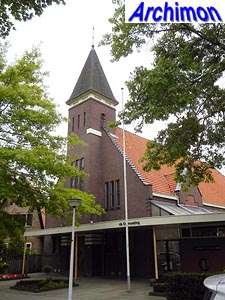
Boeyinga's first church. Church in moderate Expressionist style, with short tower at the front.
1924-1927 Amsterdam (NH) : Garden village Nieuwendam
Houses and shops in moderate Expressionist style.
1925-1926 Haarlem (NH): Gereformeerde Kloppersingelkerk
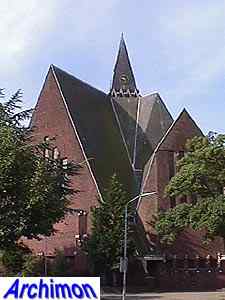
Centralized church in Expressionist style. Three 'naves' of different sizes are arranged fan-wise and meet at one point. Simplified version of a non-executed design from 1923 for a church in Amsterdam. Later renamed Koningkerk. Completely destroyed by fire in 2003.
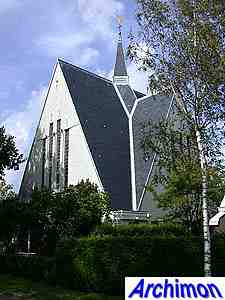
White-painted church in Expressionist style. Ground-plan is a Greek cross. Boeyinga used an earlier non-executed design for the church in Zaandijk as the basis for this one.
1927-1928 Bergen op Zoom (NB): Gereformeerde kerk
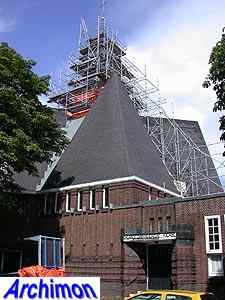
Church
in Expressionist
style, with fan-like ground-plan.
1929 Rotterdam-Hillesluis (ZH): Hervormde Maranathakerk
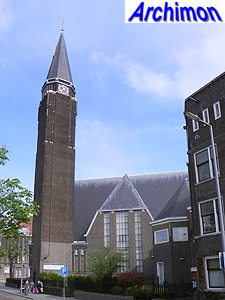
Church in Expressionist style, with fan-like ground-plan. Designed in cooperation with R.J. Hoogeveen.
1930-1931 Halsteren (NB): administration building Vrederust
Building for psychiatric institution Vrederust. Design influenced by English mansions.
1930-1932 Amsterdam (NH): laboratories Vrije Universiteit
Laboratory-building for the university founded by the denomination of the Gereformeerden. One of the last examples of Amsterdam School architecture.
1933 Ijsselmuiden (Ov): Gereformeerde kerk
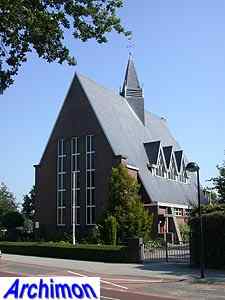
Church in moderate Expressionist style.
1934 Den Helder (NH): Gereformeerde Rehobothkerk
Church, no further details.
1934-1935 Almelo (Ov): Gereformeerde Noorderkerk
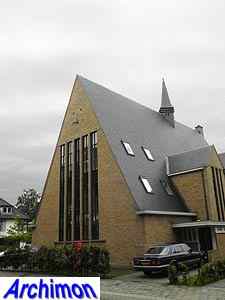
Church in Expressionist style. Rebuilt into four houses in 2006.
1935 Haarlem (NH): Gereformeerde Noordschoterkerk
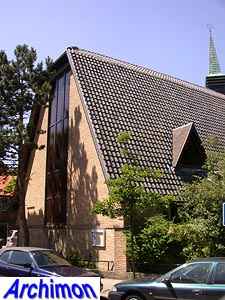
Small church in simple Expressionist style.
1935
Haarlem (NH):
Gereformeerde Zuid-Oosterkerk
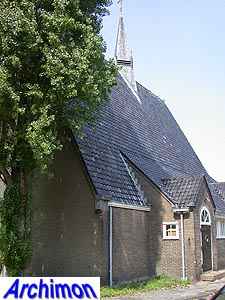
Church
in moderate
Expressionist style.
1935 Wageningen (G): Gereformeerde Bevrijdingskerk
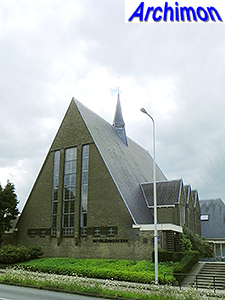
Church in moderate Expressionist style.
1935-1936 Amsterdam (NH): Waalkerk
The last of Boeyinga's churches with a fan-shaped ground-plan, but the Expressionist style is changed for a moderate version of New Objectivity. Demolished.
1936-1937 Diemen (NH): Gereformeerde Bethlehemkerk
Church in moderate Expressionist style.
1939-1940 Wassenaar (ZH): Gereformeerde Zijllaankerk
Church in Traditionalist style, inspired by early christian basilica's. Tall tower with saddleback-roof.
1946-1964 Arnhem (G): restoration Eusebiuskerk
Restoration of war-damaged Gothic church.
1947 Den Haag (ZH): Gereformeerde Maranathakerk
Temporary church. Demolished ca. 1962.
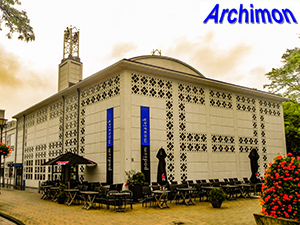
Modern church. Closed and rebuilt into a theatre.
1955 Maassluis (ZH): Gereformeerde Immanuëlkerk
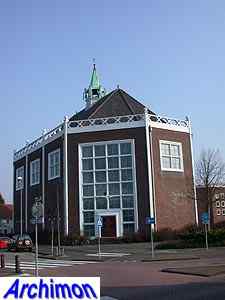
Aisleless church with polygonal endings. Inspired by a huegenot church in Calais, France. Designed in cooperation with A. Warnaar.
1955 Egmond aan Zee (NH): Gereformeerde kerk
Designed in cooperation with A. Warnaar. No further details.
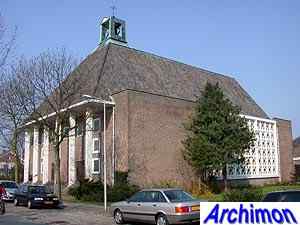
Aisleless church, designed in cooperation with A. Warnaar.
1961 Purmerbuurt (NH): Hervormde kerk
Cruciform centralizing church.
1961-1962 Sint Maarten (NH): Hervormde kerk
Boeyinga's last church, an aisleless building in a modest, Functionalist style. A first design from 1961 for a cruciform church was not accepted, the design from 1962 was. Converted into a house