
Town and municipality in a northern part of the province that unitil 1810 was part of Holland. Woudrichem started as a small settlement in the earlyMiddle Ages and became an important trading town in the 14th century. Part of the municipality are the villages Almkerk, Andel, Giessen, Oudendijk, Rijswijk, Uitwijk, Uppel and Waardhuizen. The population of the municipality, like the rest of this part of the province, is mostly protestant.
Stad en gemeente in een noordelijk gedeelte van de provincie dat tot 1810 onderdeel van Holland was. Woudrichem begon als een kleine nederzetting in de vroege Middeleeuwen en werd een belangrijke handelsstad in de 14e eeuw. Onderdeel van de gemeente zijn de dorpen Almkerk, Andel, Giessen, Oudendijk, Rijswijk, Uitwijk, Uppel en Waardhuizen. De bevolking van de gemeente is, net als in de rest van dit deel van de provincie, overwegend protestant.
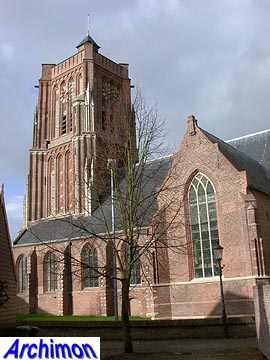
The reformed church or St. Martinus is a cruciform pseudo-basilica in Gothic style. It was largely built in the 15th century but was badly damaged in the late 16th century and rebuilt in the 17th.
Location: Kerkstraat 35
De hervormde kerk of St. Martinus is een kruisvormige pseudobasiliek in gotische stijl. De kerk werd grotendeels gebouwd in de 15e eeuw, maar werd zwaar beschadigd in de late 16de eeuw en herbouwd in de 17e.
Locatie: Kerkstraat 35
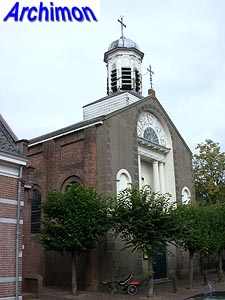
The St.Johannes Nepomuk is the only catholic church in the municipality. It's a small one-aisled building in neo-Classical style, designed by J. de Kroon and built in 1837-1838.
Location: Vissersdijk 15
De St. Johannes Nepomuk is de enige katholieke kerk in de gemeente. Het is een klein eenbeukig gebouw in neoclassicistische stijl, ontworpen door J. de Kroon en gebouwd in 1837-1838.
Locatie: Vissersdijk 15
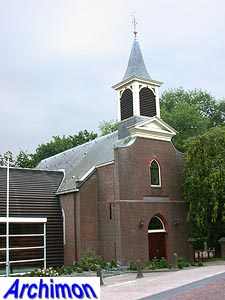
It is unknown when exactly Rijswijk's
reformed church was built but its neo-Classical facade suggests it was in
the 1820's or -30's. In 2000 the church was enlarged in modern style.
Location: Maasdijk 27
Het is onbekend wanneer precies de hervormde kerk werd gebouwd, maar de neoclassicistische gevel suggereert dat het in de jaren 1820 of 1830 was. In 2000 werd de kerk vergroot in moderne stijl.
Locatie: Maasdijk 27
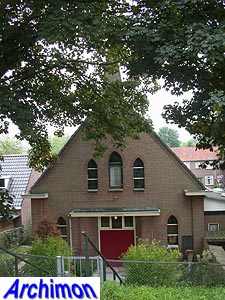
The former Gereformeerde kerk was built in 1931 and is in a moderate Expressionist style. Its architect is not known.
Location: Maasdijk 11
De voormalige Gereformeerde kerk werd gebouwd in 1931 en is in een gematigd expressionistische stijl. De architect is niet bekend.
Locatie: Maasdijk 11
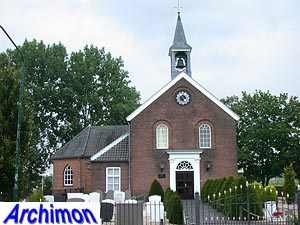
The reformed church is basically the choir of a 14th-century church of which nothing else remains, extended with a trave in 1856 and closed off with a facade in simple neo-Classical style.
Location: Kerkstraat 2
De hervormde kerk is in oorsprong het koor van een 14e-eeuwse kerk waarvan verder niets resteert, uitgebreid met een travee in 1856 en afgesloten met een gevel in eenvoudige neoclassicistische stijl.
Locatie: Kerkstraat 2
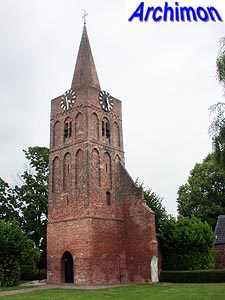
This 14th-century tower named Romboutstoren is part of the ruins of the former church of Neer-Andel and has a rare brick spire. The church was demolished, except for a chapel and parts of the walls.
Location: Hoofdgraaf 6
De 14e-eeuwse Romboutstoren is een deel van de ruïne van de voormalige kerk van Neer-Andel en heeft een zeldzame stenen spits. De kerk is gesloopt, met uitzondering van een kapel en delen van de muren.
Locatie: Hoofdgraaf 6
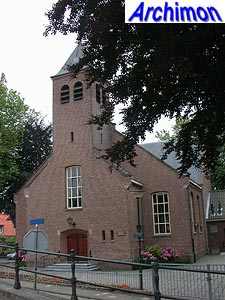
The reformed church in Op-Andel is called Blauwe Kerk ('blue church'). Its oldest part dates from the 16th century, but the church was enlarged in neo-Classical style in 1852 and in Traditionalist style by architects Bezemer and De Snoo in 1959. That same year the old part of church was restored and its blue colour, which gave it its name, was removed.
Location: Kerkstraat 2
De hervormde kerk in Op-Andel wordt de Blauwe Kerk genoemd. Het oudste deel dateert uit de 16e eeuw, maar de kerk werd vergroot in neoclassicistische stijl in 1852 en in in 1959 in traditionalistische stijl door de architecten Bezemer en De Snoo. Datzelfde jaar werd het oude deel van de kerk gerestaureerd en werd de blauwe kleur, waaraan het gebouw zijn naam ontleend, verwijderd.
Locatie: Kerkstraat 2