
Breda is the biggest city of the western part of the province of Noord-Brabant and is the centre of the eponymous diocese of the same name. Part of the city are several (former) hamlets such as Gageldonk and Heusdenhout, both of which have been absorbed by the city structure, and the former, but still seperately recognizable villages of Teteringen, Ginneken, Prinsenbeek, Princenhage, Effen, Bavel and Ulvenhout. Churches in the centre, the area surrounded by moats, are shown on this page, those outside the centre are at the next page.
Breda is de grootste stad van het westelijk deel van de provincie Noord-Brabant en is tevens het centrum van het gelijknamige bisdom. Deel van de stad zijn enkele (voormalige) buurtschappen zoals Gageldonk en Heusdenhout, die beide volledig zijn opgenomen in de stedelijke omgeving, en de voormalige maar nog apart herkenbare dorpen Teteringen, Ginneken, Prinsenbeek, Princenhage, Effen, Ulvenhout en Bavel. Kerken in het centrum, het gebied dat omringd wordt door grachten, staan op deze pagina, op de volgende pagina staan de kerken buiten het centrum.
Breda Centrum

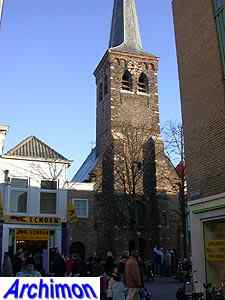
The Grote Kerk ("Great Church") or Onze Lieve Vrouwekerk ("Church of Our Lady") is an impressive example of Brabantine Gothic, and one of a very few examples of this style in The Netherlands that was actually completed. The church was taken by the protestants in 1637 and, despite an overwhelming catholic majority in the city, never returned to its original owners.
Location: Torenstraat 20
De
Grote Kerk of Onze Lieve Vrouwekerk is een
indrukwekkend voorbeeld van Brabantse gotiek, en een van de weinige
voorbeelden van deze stijl in Nederland die daadwerkelijk werden
voltooid. De protestanten eigenden zich de kerk in 1637 toe en ondanks
een overweldigende katholieke meerderheid in de stad werd de kerk nooit
meer teruggegeven aan de oorspronkelijke eigenaren.
Locatie: Torenstraat 20
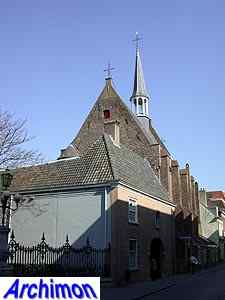
The St. Joostkapel (chapel of St. Joost) is a simple late-Gothic building that was constructed in ca. 1435. After 1637 it has had several non-religious functions. Its last function until 1945 was that of a house. In that year it became a chapel again, out of gratitude for the city's liberation.
Location: Ginnekenstraat 23
De
St. Joostkapel is een eenvoudig laat-gotische
gebouw uit ca. 1435. Na 1637 had het gebouw aantal niet-religieuze
functies. Zijn laatste functie tot 1945 was die van een woonhuis. In
dat jaar werd het gebouw weer een kapel, uit dankbaarheid voor de
bevrijding van de stad.
Locatie: Ginnekenstraat 23
The St. Wendelinuskapel was built before 1446 as the chapel of the adjacent beguinage but since 1590 it has been a Walloon church, except for an interruption from 1625 until 1649. During the first period of its excistence the chapel was only accessible from the beguinage itself. When the building changed ownership that door was closed, and a new entrance was built.
Location: Catharinastraat 83
De
St. Wendelinuskapel werd voor 1446 gebouwd als de kapel van het
aangrenzende begijnhof maar is sinds 1590 een Waalse kerk,
afgezien van een onderbreking van 1625 tot 1649.
Gedurende de eerste periode van haar bestaan was de kapel alleen
bereikbaar vanaf het begijnhof. Toen het gebouw van eigenaar wisselde
werd de deur gesloten en een nieuw portaal gebouwd.
Locatie: Catharinastraat 83
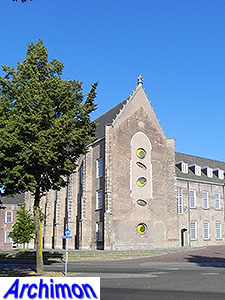
Another formerly catholic building that changed owners is the former convent St. Catharinadal, of which we see the former church here, which dates from the early-16th century. The nuns were the only ones tolerated in the Republic until in 1645 they were forced to leave Breda. From 1814 until well into the 20th century it was a barracks. It's now a casino.
Location: Kloosterplein 20
Een
andere voormalig katholiek gebouw dat van eigenaar is veranderd is het
voormalige klooster St. Catharinadal, waarvan we
hier de voormalige kerk uit de vroege 16e eeuw zien. De nonnen waren de
enigen die in de Republiek werden getolereerd, totdat ze in 1645 alsnog
werden gedwongen om Breda te verlaten. Van 1814 tot ver in de 20e eeuw
was het een kazerne. Het
is nu een casino.
Locatie: Kloosterplein 20
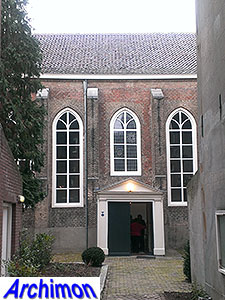
After the Reformation the occupation by often German troops gave Breda a significant Lutheran community. The current Lutheran church was built as a hidden church in 1782-1786 and was given its current appearance with pointed windows in 1838.
Location: Veemarktstraat 11
Na de Reformatie kreeg Breda door de
bezetting door veelal Duitse troepen een Lutherse gemeente van enige omvang. De huidige
Lutherse kerk werd gebouwd als een
schuilkerk in 1782-1786 en kreeg zijn huidige uiterlijk met spitsboogvensters in
1838.
Locatie: Veemarktstraat 11
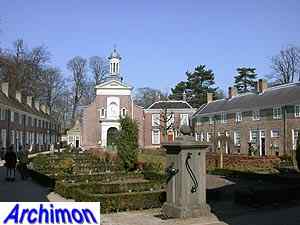 Due
to the special protection of the
princes of Orange, the beguinage was the only
catholic
institution allowed to survive in Breda after the Reformation, although
the Beguines lost their chapel to the Walloon reformed community. In 1836-1837 they finally got a new
Beguine church, a small building in
Neo-Classical style. Until then they had
held their services in modified houses.
Due
to the special protection of the
princes of Orange, the beguinage was the only
catholic
institution allowed to survive in Breda after the Reformation, although
the Beguines lost their chapel to the Walloon reformed community. In 1836-1837 they finally got a new
Beguine church, a small building in
Neo-Classical style. Until then they had
held their services in modified houses.
Location: Catharinastraat 23
Dankzij
de bescherming door de prinsen van Oranje kon het Begijnhof als enige
katholieke instelling in Breda na de Reformatie blijven bestaan, hoewel
de begijnen wel hun kapel verloren aan de Waalse gereformeerde gemeente. In 1836-1837 kregen ze een
nieuwe
Begijnenkerk, een
klein gebouw in neoclassicistische stijl. Tot dan hadden ze hun
diensten gehouden in aangepaste huizen.
Locatie: Catharinastraat 23
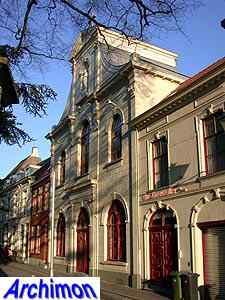
Another example of Neo-Classicism is former Maria-Hemelvaartkerk, which was built as a hidden church in 1715 and did not receive its Neo-Classical facade, designed by A.J.F. Cuypers, until 1836-1837. It's now a theatre.
Location: Waterstraat 7
Een
ander voorbeeld van het neoclassicisme is de voormalige Maria-Hemelvaartkerk,
die in 1715 werd gebouwd als een schuilkerk en pas in 1836-1837 de
neoclassicistische gevel, ontworpen door A.J.F. Cuypers,
kreeg.
Het is nu een theater.
Locatie: Waterstraat 7
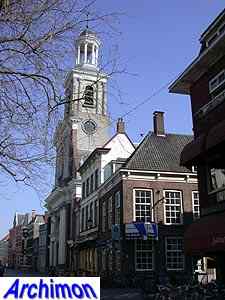
Also in 1836-1837, the St. Antonius van Padua was built, another church in Neo-Classical style, in this case designed P. Huijsers. It became Breda's first cathedral in 1853, the year when the Roman Catholic church became fully legal again. In 2001 this title returned to the church after 126 years.
Location: St. Janstraat 10
In 1836-1837 werd ook de St. Antonius van Padua gebouwd, nog een kerk in neoclassicistische stijl, in dit geval ontworpen door P. Huijsers. De kerk werd in 1853, het jaar waarin de rooms-katholieke kerk weer volledig legaal werd, de eerste kathedraal van Breda. In 2001 kreeg de kerk deze titel na 126 jaar weer terug.
Locatie: St. Janstraat 10
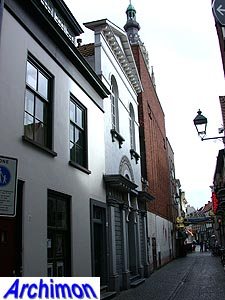
In 1845 the synagogue was built, yet another building in Neo-Classical style. A hundred years later the jewish population of Breda was almost completely destroyed, and the synagogue was in a bad state. After the war the building served as a workplace and lost its facade. In 1992 the facade was reconstructed, the building restored and became a synagogue once more.
Location: Schoolstraat 16
In 1845 werd de synagoge gebouwd, eveneens in neoclassicistische stijl. Honderd jaar later was de joodse bevolking van Breda bijna volledig verwoest en was de synagoge in een slechte staat. Na de oorlog diende het gebouw als een werkplaats en verloor zijn gevel. In 1992 werd de gevel gereconstrueerd, het gebouw gerenoveerd en werd het weer een synagoge.
Location: Schoolstraat 16
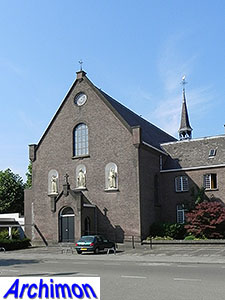
The St. Fidelis was built in 1889 as the church of a Capuchin monastery. It was designed in a simple Neo-Baroque style by A. van den Wijngaart. The monastery was closed in 2013.
Location: Schorsmolenstraat 11
De St. Fidelis werd gebouwd in 1889 als de kerk van een kapucijner klooster. Het werd ontworpen in een eenvoudige neobarokke stijl van A. van den Wijngaart. Het klooster werd gesloten in 2013.
Locatie: Schorsmolenstraat 13
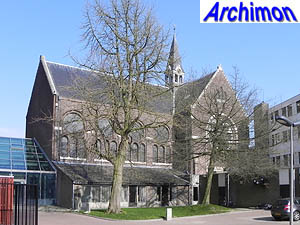
The St. Elisabeth chapel was built in 1899 as part of a hospital, of which nothing else remains. It was designed by P.J. van Genk in a more or less Neo-Romanesque style.
Location: Leuvenaarstraat
De St. Elisabethkapel werd in 1899 gebouwd als deel van een verzorgingstehuis waarvan verder niets resteert. Zij werd ontworpen door P.J. van Genk in een min of meer neoromaanse stijl.
Locatie: Nieuwstraat 27
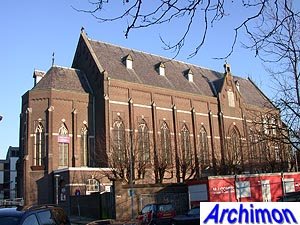
Local architect J. Lijdsman designed the Neo-Gothic Franciscan convent chapel in 1896 already, but it was built in 1904-1905. In 2014, it was rebuilt into a block of apartments.
Location: Nieuwstraat 27
De plaatselijke architect J. Lijdsman ontwierp de neogotische Franciscaner kloosterkapel al in 1896 maar deze werd pas gebouwd in 1904-1905. In 2014 werd zij verbouwd tot appartementen.
Locatie: Nieuwstraat 27