
Halderberge municipality / Gemeente Halderberge (NB)
Municipality in the western part of the province, founded in 1997 when the municipalities of Hoeven, Oudenbosch and Oud en Nieuw Gastel merged. Among the places in the municipality are Hoeven and Oudenbosch. The latter village is of special interest for its large concentration of monasteries and convents and its two copies of the St. Peter in Rome.
Gemeente in het westelijke deel van de provincie, ontstaan in 1997 door samenvoeging van de gemeenten Hoeven, Oudenbosch en Oud en Nieuw Gastel. Enkele plaatsen in de gemeente zijn Hoeven en Oudenbosch. Dit laatste dorp is van bijzondere interesse vanwege de grote concentratie van kloosters en de twee kopieën van de St. Pieter in Rome.
Oudenbosch
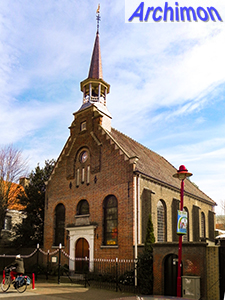
The oldest church in Oudenbosch is the Reformed church, a small building in simple Neo-Classical style built in 1819, 20 years after the protestant minority was forced to give back the old village church to the catholics.
Location: Fenkelstraat 24
De oudste kerk in Oudenbosch is de Hervormde kerk, een klein gebouw in eenvoudige neoclassicistische stijl uit 1819, 20 jaar nadat de protestantse minderheid gedwongen werd om de oude dorpskerk terug te geven aan de katholieken.Locatie: Fenkelstraat 24
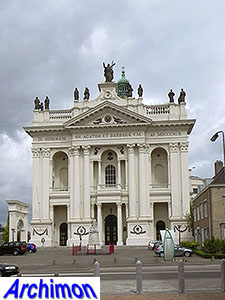 In
the 1860's it was decided to replace the old village church by a copy
of the St. Peter in
Rome as part of a plan to make the village the 'Rome of the North'.
P.J.H.
Cuypers, more famous for his Neo-Gothic churches, designed
the new building. This Basiliek
van de H.H. Agatha en
Barbara ("Basilica of Saints Agatha and Barbara")
is a 1:3th-scale copy, but its facade is inspired by
the St. John Lateran and was added in 1892 after a design of architect
G.J. van Swaay.
In
the 1860's it was decided to replace the old village church by a copy
of the St. Peter in
Rome as part of a plan to make the village the 'Rome of the North'.
P.J.H.
Cuypers, more famous for his Neo-Gothic churches, designed
the new building. This Basiliek
van de H.H. Agatha en
Barbara ("Basilica of Saints Agatha and Barbara")
is a 1:3th-scale copy, but its facade is inspired by
the St. John Lateran and was added in 1892 after a design of architect
G.J. van Swaay.Location: Markt 57
In de jaren 1860 werd besloten om de oude dorpskerk te vervangen door een kopie van de St. Pieter in Rome, als onderdeel van een plan om van het dorp het 'Rome van het Noorden ' te maken. P.J.H Cuypers, bekender om zijn neogotische kerken, ontwierp het nieuwe gebouw. Deze Basiliek van de HH Agatha en Barbara is een kopie op schaal 1:3, maar de gevel is geïnspireerd op de St. Jan van Lateranen en werd in 1892 toegevoegd naar een ontwerp van architect G.J. van Swaay.
Locatie:
Markt 57
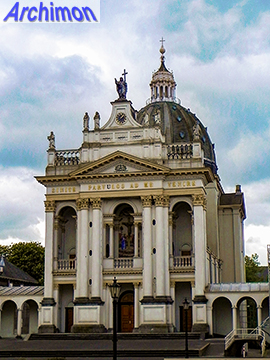
The chapel of the Instituut Saint-Louis, a boarding school for catholic boys, is a scaled down version of the basilica. It was built in 1865-1866 and was designed by Th. Florschütz and J. Boosten. In 1888-1889 a dome was added designed by G.J. van Swaay.
Location: Markt 32-34
De kapel van het Instituut Saint-Louis, een katholiek jongensinternaat, is een verkleinde versie van de basiliek. De kapel werd gebouwd in 1865-1866 en was ontworpen door Th. Florschütz en J. Boosten. In 1888-1889 werd een koepel werd toegevoegd, ontworpen door G.J. van Swaay.
Locatie: Markt 32-34
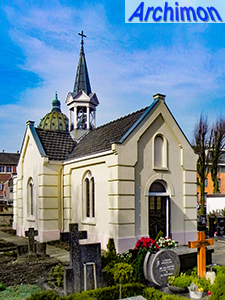
In 1894 the St. Barbarakapel ('St. Barbara chapel') was built on the site of the demolished old church. This cemetery chapel is in a more or less Neo-Romanesque style and was designed by G.J. van Swaay.
Location: St. Bernaertsstraat
In 1894 werd de St. Barbarakapel gebouwd op de plaats van de gesloopte oude kerk. Deze begraafplaatskapel werd door G.J. van Swaay ontworpen in een min of meer neoromaanse stijl.
Locatie: St. Bernaertsstraat
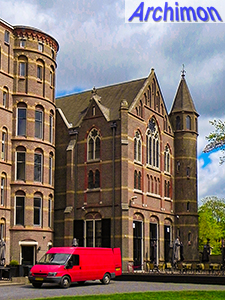
The Jesuite seminary Collegium Berchmanianum was a big complex in a combination of Neo-Gothic and Neo-Renaissance styles, designed by N. Molenaar Sr.. Part of the complex was demolished in 1971, but the main building with the Neo-Gothic chapel built in 1889-1890, became a hotel.
Location: Markt 66-68
Het Jezuïetenseminarie Collegium Berchmanianum was een groot complex in een combinatie van neogotiek en neorenaissance, ontworpen door N. Molenaar Sr.. Een deel van het complex werd gesloopt in 1971, maar het hoofdgebouw met de neogotische kapel uit 1889-1890 werd een hotel.
Locatie: Markt 66-68
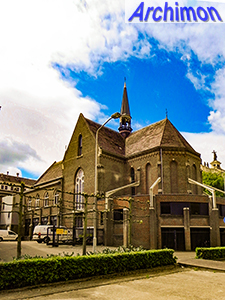
The Neo-Gothic chapel of the Franciscan convent of St. Anna was probably designed by J. van Groenendaal en J. Hurks and built in the late 1920's. It is now the local public library while the rest of the convent is nowadays town hall.
Location: Markt 61
De neogotische kapel van het Franciscanessenklooster St. Anna werd waarschijnlijk ontworpen door J. van Groenendael en J. Hurks en gebouwd in de late jaren 1920. Het is nu de plaatselijke openbare bibliotheek, terwijl de rest van het klooster tegenwoordig dient als gemeentehuis.
Locatie: Markt 61
Hoeven
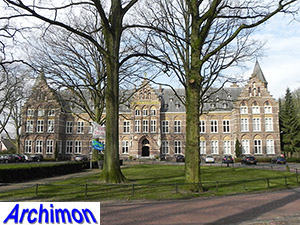
Bovendonk is a large Neo-Gothic complex designed by P.J.H. Cuypers and built in 1903-1907. It was the major seminary of the Breda diocese until 1967.
Location: Hofstraat 8
Bovendonk is een groot neogotisch complex, ontworpen door P.J.H. Cuypers en gebouwd in 1903-1907. Het was tot 1967 het grootseminarie van het bisdom Breda.
Locatie: Hofstraat 8
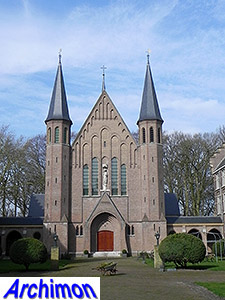
Although a chapel was added to the seminary in 1915-1916, in 1922-1923 it was already replaced by a new, larger one by J.Th.J. Cuypers.
Location Hofstraat 8
Hoewel in 1915-1916 een kapel werd toegevoegd aan het seminarie, werd deze al in 1922-1923 vervangen door een nieuw, groter gebouw naar ontwerp van J.Th.J. Cuypers.
Locatie: Hofstraat 8
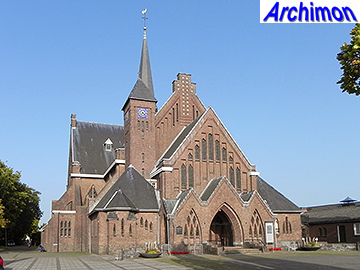
The church St. Johannes de Doper was built in 1928-1929 and was designed in Expressionist style by architect J. Berben.
Location: St. Jansstraat 40
De kerk St. Johannes de Doper werd gebouwd in 1928-1929 en werd in expressionistische stijl ontworpen door architect J. Berben.
Locatie: St. Jansstraat 40
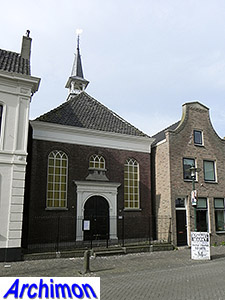
The Neo-Classical reformed church was built in 1809 and is a typical example of a protestant church built during the reign of Lodewijk Napoleon, king of the so-called Kingdom of Holland, who personally financed such churches in places where the protestant minority was forced to return the old church to the catholics.
Location: Dorpsstraat 13
De neoclassicistische Hervormde kerk werd gebouwd in 1809 en is een typisch voorbeeld van een protestantse kerk gebouwd tijdens het bewind van Lodewijk Napoleon, koning van het zogenaamde Koninkrijk Holland, die persoonlijk zulke kerken financieerde op plaatsen waar de protestantse minderheid werd gedwongen om de oude kerk terug te geven aan de katholieken.
Locatie: Dorpsstraat 13
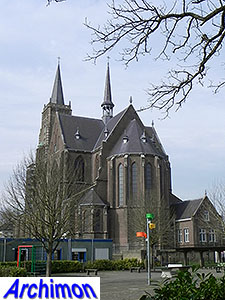
The St. Laurentius is a Neo-Gothic cruciform basilica designed by G.J. van Swaay and built in 1906. Incorporated is the Gothic tower of its late-15th century predecessor.
Location: Kerkstraat 3
De St. Laurentius is een neogotische kruisbasiliek, ontworpen door G.J. Van Swaay en gebouwd in 1906. De gotische toren van de laat-15e eeuwse voorganger bleef behouden.
Locatie: Kerkstraat 3
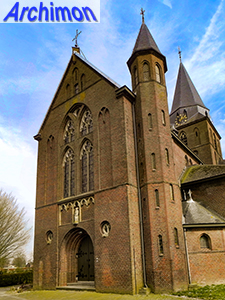 The church
H.H. Martelaren van Gorkum is a late Neo-Gothic church, designed by
W. te Riele and built in 1924. The church is almost identical to the
St. Jacobus de Meerdere in Lonneker (Ov) which Te Riele built in 1911-1912.
The church
H.H. Martelaren van Gorkum is a late Neo-Gothic church, designed by
W. te Riele and built in 1924. The church is almost identical to the
St. Jacobus de Meerdere in Lonneker (Ov) which Te Riele built in 1911-1912.Location: Dennis Leestraat 25
De H.H. Martelaren van Gorkum is een laat-neogotische kerk, ontworpen door W. te Riele en gebouwd in 1924. De kerk is bijna identiek aan de St. Jacobus de Meerdere in Lonneker (Ov), die Te Riele bouwde in 1911-1912.
Locatie: Dennis Leestraat 25
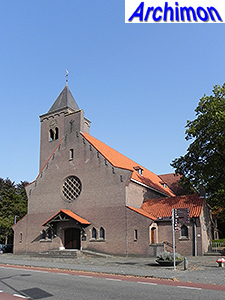
The church Heilig Hart van Jezus was built in 1927 as a neo-Gothic church designed by W. te Riele. In 1950-1952 its nave and tower, which had been destroyed in 1945, were replaced by new ones in Traditionalist style by design of J. Hurks.
Location: Pastoor van Breugelstraat 51
De kerk Heilig Hart van Jezus werd in 1927 gebouwd als een neo-gotiek kerk ontworpen door W. te Riele. In 1950-1952 werden het schip en de toren, die beide in 1945 waren verwoest, vervangen door nieuwe in traditionalistische stijl naar ontwerp van J. Hurks.
Locatie: Pastoor van Breugelstraat 51
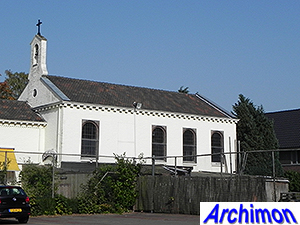 The chapel of
St. Stanislaus, a monastery for novices, was designed by
F.B. Sturm or his son L. Sturm, like the rest of the complex. The whole
monastery is in a simple Traditionalist style and was built in 1953-1954.
It's now a hotel.
The chapel of
St. Stanislaus, a monastery for novices, was designed by
F.B. Sturm or his son L. Sturm, like the rest of the complex. The whole
monastery is in a simple Traditionalist style and was built in 1953-1954.
It's now a hotel.Location: Pastoor van Breugelstraat 45
De kapel van St. Stanislaus, een novicenklooster, werd ontworpen door F.B. Sturm of zijn zoon L. Sturm, net als de rest van het complex. Het hele klooster heeft een eenvoudige, traditionalistische stijl en is gebouwd in 1953-1954. Het is nu een hotel.
Locatie: Pastoor van Breugelstraat 45