
Unlike early neo-Gothic, the actual neo-Gothic, also called rationalist neo-Gothic, was not a rediscovery of Gothic but rather a rebirth of that style. Some of the important differences between the two similarly named styles are:
- Early neo-Gothic borrowed elements from Gothic for decorative use without any understanding of the ideas behind them. Neo-Gothic on the other hand actually tried to understand the basic principles of Gothic, and used them; early neo-Gothic was still closely related to neo-Classicism both in general shape of the buildings as in the use of materials; usually only the shapes of the details differed.
- In early neo-Gothic churches the use of imitations of natural materials was standard practise, in neo-Gothic it was almost unacceptable.
- Early neo-Gothic usually shows a close relation to English Gothic styles, while neo-Gothic at first was strongly inspired by French and German Gothic examples, and by indigenous ones at a later stage.
- Early neo-Gothic churches were often plastered or painted, neo-Gothic churches were not.
Many architects, such as C. Weber, H.J. van Tulder and Th. Molkenboer, took elements from both neo-Gothic styles and combined them for several decades, making the boundary between the two very thin eventually. In this second fase of early neo-Gothic, the three-aisled cruciform ground plan was more common, as well as real towers. Proportions however are often strange, while plaster was still used for ornaments and vaults.
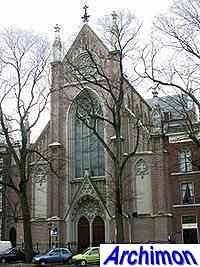 The Redemptorist church in Amsterdam (left) is often
considered to be the first big church in true neo-Gothic style in the
Netherlands. It was built from 1852 until 1854, and its design was made by Th. Molkenboer,
who took the Redemptorist church in Mons (Belgium) as an example.
Molkenboer was at that time the leading church-architect in the
Netherlands. Although he was a typical representative of his
generation,
designing in the then fashionable styles of neo-Classicism and early neo-Gothic,
this building definitely exceeds that latter style. Instead of just
using some more or less authentic looking Gothic elements, here the
architect actually had studied the medieval examples well enough to
come up with a design that closely resembled them both in style and
construction. It has three aisled, with a clerestorey at the top of the
central one. However, Molkenboer and similar architects like H.J. van den Brink never reached the point of actual neo-Gothic, if only because
of their continued use of plaster vaults.
The Redemptorist church in Amsterdam (left) is often
considered to be the first big church in true neo-Gothic style in the
Netherlands. It was built from 1852 until 1854, and its design was made by Th. Molkenboer,
who took the Redemptorist church in Mons (Belgium) as an example.
Molkenboer was at that time the leading church-architect in the
Netherlands. Although he was a typical representative of his
generation,
designing in the then fashionable styles of neo-Classicism and early neo-Gothic,
this building definitely exceeds that latter style. Instead of just
using some more or less authentic looking Gothic elements, here the
architect actually had studied the medieval examples well enough to
come up with a design that closely resembled them both in style and
construction. It has three aisled, with a clerestorey at the top of the
central one. However, Molkenboer and similar architects like H.J. van den Brink never reached the point of actual neo-Gothic, if only because
of their continued use of plaster vaults.  The
Amsterdam claim can be disputed, though. Those that hailed Molkenboer's church
when it was completed, like catholic writer and art critic J.A. Alberdingk Thijm,
where mostly located in Amsterdam itself and were unaware of what happened in
other parts of the country. In 1850, two
year before work began on the Amsterdam church, German architect C. Weber enlarged the church of Panningen (L)
in such a way that it resulted in a mostly neo-Gothic church. This would make
Weber the first architect to build a church in a truly neo-Gothic style, not
Molkenboer. However, Weber's church was a Stuffenhalle, a German type of hall-church not commonly
associated with Gothic, while Molkenboer's church was a basilica with the right
Gothic proportions. The first church Weber entirely designed himself, the
church of Amstenrade, was built in 1852-1856 and is also
a Stuffenhalle. It has a mostly Gothic construction but with plaster vaults and an early
neo-Gothic ornament at the portal. Weber designed many more churches in
neo-Gothic style but is mostly remember for a series of impressive neo-Romanogothic
churches built in the 1890's.
The
Amsterdam claim can be disputed, though. Those that hailed Molkenboer's church
when it was completed, like catholic writer and art critic J.A. Alberdingk Thijm,
where mostly located in Amsterdam itself and were unaware of what happened in
other parts of the country. In 1850, two
year before work began on the Amsterdam church, German architect C. Weber enlarged the church of Panningen (L)
in such a way that it resulted in a mostly neo-Gothic church. This would make
Weber the first architect to build a church in a truly neo-Gothic style, not
Molkenboer. However, Weber's church was a Stuffenhalle, a German type of hall-church not commonly
associated with Gothic, while Molkenboer's church was a basilica with the right
Gothic proportions. The first church Weber entirely designed himself, the
church of Amstenrade, was built in 1852-1856 and is also
a Stuffenhalle. It has a mostly Gothic construction but with plaster vaults and an early
neo-Gothic ornament at the portal. Weber designed many more churches in
neo-Gothic style but is mostly remember for a series of impressive neo-Romanogothic
churches built in the 1890's.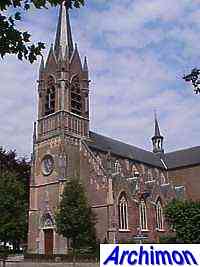
One of a few architects who successfully made the transition from early to rationalist neo-Gothic was H.J. van Tulder. His catholic St. Lucia in Mierlo (NB) from 1856-1858 shows elements of both styles. Although executed in unplastered brick most of the ornaments are typical for early neo-Gothic.
 Under
the influence of E.
Viollet-le-Duc and of Dutch artcritic and poet J.A. Alberdingk Thijm,
one of the leaders in the movement for equal rights for catholics,
Cuypers tried to fully understand the medieval Gothic principles before
allowing himself to move on. This second period in his career started
in ca. 1870, and Cuypers from that time combined new ideas with the
Gothic principles. An important example is his Vondelkerk
in Amsterdam, which combines German Gothic and Romanogothic influences
with centralizing elements. A far cry from Cuypers' first works, like
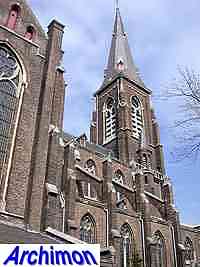
the St.
Martinus in Maastricht (right). But Cuypers is one of only a
very few architects who are willing to experiment. For A. Tepe Gothic
is
already the point of arrival, and his work shows little to no
evolution. While Cuypers mostly takes his inspiration from early French
(and to a lesser degree, German) Gothic, Tepe takes his from
indigenous late-Gothic styles. Weber's work is inspired by both French
and German
Gothic, before moving towards a much more Romanogothic style. His
neo-Gothic work is generally not regarded his best, and often shows a
rather conservative approach to the style.
Under
the influence of E.
Viollet-le-Duc and of Dutch artcritic and poet J.A. Alberdingk Thijm,
one of the leaders in the movement for equal rights for catholics,
Cuypers tried to fully understand the medieval Gothic principles before
allowing himself to move on. This second period in his career started
in ca. 1870, and Cuypers from that time combined new ideas with the
Gothic principles. An important example is his Vondelkerk
in Amsterdam, which combines German Gothic and Romanogothic influences
with centralizing elements. A far cry from Cuypers' first works, like
the St.
Martinus in Maastricht (right). But Cuypers is one of only a
very few architects who are willing to experiment. For A. Tepe Gothic
is
already the point of arrival, and his work shows little to no
evolution. While Cuypers mostly takes his inspiration from early French
(and to a lesser degree, German) Gothic, Tepe takes his from
indigenous late-Gothic styles. Weber's work is inspired by both French
and German
Gothic, before moving towards a much more Romanogothic style. His
neo-Gothic work is generally not regarded his best, and often shows a
rather conservative approach to the style.Of these three architects Cuypers is definitely the most important, and he built churches in most parts of the country. A refusal to settle in Utrecht lead to a boycot in this archdiocese; only in those regions far from the episcopal city of Utrecht, like the provinces of Friesland and Groningen, did he manage to get some assignments. It's A. Tepe who is the favoured architect of the archdiocese. This architect on the other hand gets relatively few assignments outside this territory. C. Weber starts his career in the province of Limburg (the diocese of Roermond), where he is Cuypers' greatest rival, but eventually concentrates his attention on the diocese of 's-Hertogenbosch. In the diocese of Breda P.J. van Genk (1844-1919) became the most important architect for new churches, which in most cases show a clear influence from Belgian neo-Gothic, probably the result of Van Genk's education in Antwerpen, with a prominent use of natural stone combined with brick.
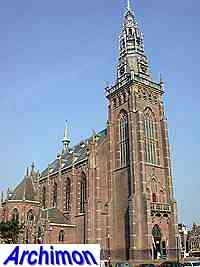
While protestants had built churches in the early neo-Gothic style, after 1853 they quickly looked for other styles. Only a very few examples of protestant churches in neo-Gothic style have ever been built since. One of these is the reformed church of Schagen (NH), designed by J.A.G. van der Steur and built in 1895-1897, but even this example is built in a style very different from catholic churches of that time. Gothic influences continued to be used, but usually in combination with other styles.
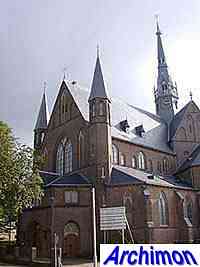
Until ca. 1914 neo-Gothic remained the dominant style for catholic churches. By that time however it had received some serious competition from other styles. While neo-RomanoGothic, with C. Weber as the most prominent architect, is of a very limited importance only, the neo-Romanesque style did reach considerable popularity. Especially some other students of Cuypers, like his son Jos. Cuypers and Jan Stuyt, were co-responsible for new developments in style, and were among the first to break the neo-Gothic monopoly. Buildings in neo-Gothic style were built for several more decades. By that time the style had lost most of its original character, and was mostly favoured by older architects. The O.L. Vrouwe Onbevlekte Ontvangenis in Hilversum is an example of a late neo-Gothic church; the traditional ideas of neo-Gothic had been abandoned, and the style is mixed with more modern influences, most notably a centralized ground-plan. It was designed by W. te Riele Gzn. and built in 1910.